Monday, May 11, 2015

3 Ways to Enjoy Little Rock

Arkansas in general has long been plagued by the stereotype of being a breeding pool of red necks. And its capitol city, Little Rock, probably doesn’t have a very substantial reputation at all. But as an Arkansas native and a University of Arkansas at Little Rock graduate, I will gladly attest that there is a lot more going on in this mid-size city than most people realize. Here are just three ways that you can rock at life in The Rock!

Stay Fit

A view from the Clinton Presidential Park Bridge.
No expensive gym membership is necessary to get a regular work out in Little Rock thanks to the Arkansas River Trail System. This 88.5 mile loop is a “tribute to outdoor recreation, conservation, wellness, and the diverse geographies of Central Arkansas." It covers two metropolitan areas, 38 parks, 12 museums, 4 bridges and 5,000+ acres of federal, state, and local parkland in Little Rock and her neighboring cities. 

Walking on the Clinton Presidential Park Bridge.
It’s a great option for getting outside and getting active. My favorite section follows along the Arkansas River on one side with downtown Little Rock on the other, providing both beautiful scenery and easy access to shops and restaurants. ‘Cause, you know...we can’t all be too hardcore to resist stopping by the River Market for ice cream. And there’s no better motivation for exercise than a few hundred fresh calories to work off, right?

And if you go at night, you definitely have to check out the Big Dam Bridge (yes, that is the official name). Spanning 4,200 feet, it’s the longest bridge in the world to be built solely for the use of pedestrians and cyclists and is completely lit up in moving colors after dark.


Stay Sharp

There are a number of museums and galleries throughout the city with free or cheap admission, so a fun and educational family outing is easy to plan.

Personally, my top recommendation is the Historic ArkansasMuseum. Here you’ll find 5 pre-civil war houses right in the middle of downtown Little Rock-including the city’s oldest-that have been preserved as the city grows up around them. The museum galleries are completely free and feature pieces from local artists as well as historic exhibits. The knife gallery, for example, houses knives from all over the world, including several Bowie knives (a.k.a. “Arkansas toothpicks”). Out on the grounds, you can interact with living history characters representing people who actually lived in the houses and can even bring along a picnic if you want to have lunch on the lawn. The museum area is free, and the historic grounds? Kids and seniors can enter for only a dollar a piece, while adult tickets come in at a whopping two dollars and fifty cents.

Science Experiments at the Museum of Discovery.
Taken from their Facebook page.
Of course, if you’re herding around little science enthusiasts, you’ve got to check out the Museum of Discovery. Located right on the river front, its mission is to “ignite a passion for science, technology and math in a dynamic, interactive environment.” 

They host several fun programs, including one for adults only called “Science After Dark.” It takes place during the evening on the last Thursday of every month and, from what I understand, sometimes features adult beverages.

Some "foreign" guests hanging out at the Museum of Discovery.
Taken from their Facebook page.
This museum isn't free, but certainly worth the price if you take your time and enjoy it. Adult admission is $10 while kids, seniors, teachers, active and retired military, and Little Rock city employees all get in for $8. Science After Dark is $5.

And while you’re there, why not walk right down the street and check out The Witt Stephens Jr.Central Arkansas Nature Center? The center aims to educate folks on the Natural State’s many outdoor recreational opportunities provided by its fish and wildlife resources.  The main building includes an exhibit hall and aquariums that are totally free to the public. It's right by the river and is even connected to the Arkansas River Trail. And, on the last Monday evening of every month, some of us local archaeologists and history lovers grace it with our quirky presences for free lectures hosted by the Arkansas Archaeological Society’s Toltec Research Station.

And these are just a few options! There are plenty more to check out, including the Clinton Presidential Center and Park, the Old State House Museum, the Arkansas Arts Center, Heifer International’s Heifer Village, and more!

Stay in Tune

Now, any local musician will warn you that it is really hard to get famous out of Little Rock. There just isn’t a large enough music scene.

However, if you’re not a musician trying to make it big, you can really benefit from Little Rock’s small-but-persistent music underground.

For one, it's big enough to have multiple venues to choose from but small enough to host a fairly tight-nit community. Many Little Rockians from teens to thirties know where to go for live music and can bond with total strangers over memories at a particular venue. Many of us have enjoyed beer and pizza while listening to some screamo nonsense at Vinos, pushed through the crowd to get closer to the stage at the Rev Room, and at least stood at the edge of a mosh pit at Jaunita’s.

An ode to music outside of the Revolution Music Room.
And, because there aren’t enough people interested in most bands to fill up an auditorium at a hundred bucks a pop, those of us who are interested get to see them at smaller and more intimate venues for way cheaper. For example, Blue October is coming to Juanitas this week and all tickets are $27. They’re going to Austin a few days later and the only tickets still available are $155. I’ve seen some great acts including Matisyahu, Relient K, and the All-American Rejects for less than 30 bucks a ticket (fun fact: I got cussed out by the All-American Rejects' lead vocalist Tyson Ritter after the show for calling him out on his bs).

You can keep up to date on a lot of local venues here.

Of course, not everyone wants to rock out. Those with a more classical taste in music are sure to find entertainment as well! The Arkansas Symphony Orchestra puts on a variety of concerts, sometimes inviting guest singers or performers to join them on stage. As a matter of fact, in October they’ll be teaming up with the circus to provide an entertainment experience that is both audibly and visually exciting! And how outrageous are the prices for such an evening? They start at just $19. AND, thanks to Entergy, you can also get a free ticket for one child from kindergarten to high school as long as you purchase an adult ticket as well.

A performance made possible by the UALR Dept of Music.
Taken from their Facebook page.
If you’re interested in something a little lower profile and less crowded, just check the University of Arkansas at Little Rock’s concert schedule. They have things happening pretty regularly throughout the academic year. Of course, students have to perform as part of attaining a degree in the performing arts, but professors sometimes show off their talents as well. You can find anything from solo piano recitals to jazz ensembles...often without an admission fee.   

Saturday, May 9, 2015

Why Don't Black People Have Their Crap Together?

It's the question on every white person's mind. I mean, predominately black neighborhoods still have lower employment rates and higher crime rates than predominately white ones, even though slavery has been long abolished.

So what is the problem here?

Some people insist that racism is subtly but effectively infecting the institutions and workings of our society, and thus playing a significant part in the destinies of our country’s black citizens. Others would argue that in a free and modern democracy like ours, everyone is control of their own destiny, and that many blacks lack the motivation or work ethic to pull themselves out of poverty.

Which is less realistic? Rampant racism or rampant laziness? Honestly, we could theorize all day about either one. But let’s look at the numbers, shall we?

Is there actually an economic gap between blacks and whites in America?

The unemployment rate for African Americans in a given area is often about twice that of whites. And although more blacks and other minorities are attending college these days, white students are increasingly enrolling in selective institutions while blacks are mostly sticking to open access and community colleges. Students who attend quality universities are more likely to graduate, go to grad school, and earn a higher salary. Which leads us full circle back to different unemployment rates. So why don’t black people either just get a job or work hard to get into a good school? Let’s dissect those two options one at a time.

Why not just get a job?                                                                    

They’ve got affirmative action on their side, so why aren’t they out there in the work force?

Marianne Bertrand and Sendhil Mullainathan, two Faculty Research Fellows at the National Bureau of Economic Research, probed at least one facet of the issue by conducting an experiment from July 2001-January 2010. They gathered over 5,000 resumes and sent them as responses to over 1,300 employment ads in the sales, administrative support, clerical, and customer services job categories. But here’s where it gets interesting-they put false names on the resumes...some distinctively black sounding (like Lakisha and Jamal), others more white sounding (like Greg and Emily).

And what did they find? Employers are 50% less likely to call back people with black sounding names. And the trend held true across all of the occupation and industry categories covered, even those sometimes considered to be severely constrained by affirmative action laws.

Does this mean that there are a bunch of bigoted KKK leaders out there in corporate America, dreaming of bringing slavery back to the states? No. But it does mean that in general, black names still carry an unfair negative taste in the mouths of many whites. This is where racism is the most persistent...when it is the most subtle. I doubt many of the employers who unknowingly took part in this experiment would identify themselves as racists.

But of course, in this day and age, you often need an education to get an occupation. More black graduates with quality degrees from prestigious universities would certainly help deteriorate employer bias over time. So let’s move on to the next question.

Why not work hard and go to a good school?

Even if you come from a poor family, you can work hard and get a scholarship. And if you’re black, you already meet one necessary qualification for a number of them. So what’s the problem here?

Well, for one, there actually is a disconnect between the qualifications of young students of color and the caliber of university they end up going to. 30 percent of African American students who earned an A average while in high school somehow still end up attending community colleges, compared with only 22 percent of whites. That means that almost a third of black students with high GPAs are going to lower-quality colleges where less funding is spent per student and students are more likely to drop out.

But let’s back it up even further. Let’s talk about Jim Crow for a second. According to www.u-s-history.com, Jim Crow Laws were “statutes and ordinances established between 1874 and 1975 to separate the white and black races in the American South. In theory, it was to create ‘separate but equal’ treatment, but in practice Jim Crow Laws condemned black citizens to inferior treatment and facilities.” That’s right...the “separate but equal” charade lasted right into the 1970’s. Within the lifetimes of many people living in the U.S. today. As a matter of fact, the Federal Housing Association blatantly participated in institutionalized racism all the way up to 1968 by denying housing loans to people based on their ethnicity.

To think that the effect those laws had on the American people all vanished when they did is pretty illogical. And not only does it defy logic, but it defies the evidence. For example, residential communities are definitely still highly divided along racial lines.

And as UpWorthy’s Franchesca Ramsey explains, “If your grandmother was denied a home loan or employment in the '50s because she was black, that influenced where your parents grew up, which then affected where you grew up. Where you live determines where you go to school, and since the community's tax dollars support local schools, it's easy to see why poor neighborhoods end up with poorly funded schools.”

And, of course, poorly funded means poorly equipped to prepare students for the next step of their education. 

Now let's wrap it up

So, Why don’t black people have their crap together? Is it because America the Free has set before them a plate of fresh-cooked equality and they’re just too darn lazy take a bite? Or could there be more complex factors at work?

Honestly, in the interest of keeping this a blog post and not a text book, I’ve really only scratched the surface of the issue. But I hope I've given you enough to draw at least a preliminary conclusion.

Saturday, May 2, 2015

Reacting to Baltimore: Sweeping Generalizations VS.. Sweeping Degeneralizations

Once again, I’ve noticed a trend in white commentary on Baltimore. And I know people are growing weary of discussing the issue. But it’s still an issue worth discussing, so discussion isn’t about to stop.  And thus, I’d like to respectfully address the following argument:

“Not all black people are thugs. Not all police officers are bad. Not all white people are racist.”

Although totally true, statements like these are not useful at best and harmful at worst.

In my experience, this sentiment can be translated in a couple of ways: “let’s just stop talking about it” or “I’m frightened by the demonization of the police, but I swear I’m not racist!” Either way, and no matter how well intentioned, it is used to shut down a very important conversation that is worth having.

You see, I completely agree that sweeping generalizations are harmful. Stereotyping all blacks as thugs is obviously harmful to black people and black communities. Stereotyping all whites as racist is unfair and distances those who are sympathetic toward the plight of their darker-skinned neighbors. And stereotyping all police officers as violent bullies paints good, integrity-filled men and women in a negative light which they never earned and diminishes the respect which they did.

But here’s the thing...sweeping degeneralizations (yes, I know that’s not technically a word) are also harmful. As I said before, they can only hinder a discourse that needs to take place no matter how messy it may get.

No, not all black people are thugs. But if someone is being treated unfairly-even killed-because of that stereotype, we need to seek justice for them and their families. And, accordingly, we need to investigate the police involved in said situation. Not only should they face a just punishment, but they should be removed from the police force so as to no longer taint the relationship of the police force with the people who rely upon them. And even though we all would like to see ourselves as free from the Scarlet Letter of racism...I’m pretty sure every last person on the planet is at least a little bit racist. It’s hard to escape unintentional stereotyping of others based on how they look or where they’re from. That’s why we all need to be willing to question our own perceptions and motives. Because racism doesn’t consist simply of the “big things” like slavery or segregation. Indeed, racism is so dangerous because it can be so subtle. 


In conclusion, I would like to congratulate Baltimore concerning chief prosecutor Mosby’s decision to charge the officers involved in the murder of Freddie Gray. Hopefully this is just one of many steps towards a freer, more equal America in which those who would abuse their power are no longer allowed to harm those over whom they wield it and no longer allowed to slander the names of others who hold that same power with more noble hands.

Wednesday, April 29, 2015

Reacting to Baltimore: Do You Really Need a Pretty Please?

In the discussion of Baltimore, and in the general issue of police violence towards blacks, I’m hearing a lot of similar comments from white friends and acquaintances. 

Of course, there are always those who are simply determined to not question the integrity of the police, especially against the word of urban blacks.

However, there are others who are willing to concede to the at least possible extremity of police responses in at least certain situations. And yet of all the players in this issue, the angry rioters always seem to steal the attention. I hear comments such as, “but still, there is no excuse for lawlessness” and “if you want the cops to be more nice to you, why would you burn down your own town?”

And to these questions, and with present restraint from addressing other facets of the situation, I would like to make this simple point:

As a member of the human race, my responsibility to consider the concerns of others is not contingent upon how they appeal for that consideration. My charge to acknowledge the suffering of others is not dependent upon the way in which they make me aware of that suffering. My inherent duty to face the problems interwoven into the very fabric of my homeland does not change according to how others have chosen to face those problems.

Closing my eyes to what’s in front of me because I don’t understand it does not excuse me from being a witness and closing my ears to a shouting voice because I wish it were whispering does not change the content of its words.


Whether by action or inaction, we are all writing the pages of our children and grandchildren’s history books. Consider carefully what part you’re playing.

Friday, April 24, 2015

#fieldtechlife


So for the past month or so, I did some cultural resource management work (CRM). When I land one of these temporary gigs it means I get paid to do "archaeology."

It's not what you think.

We were doing Phase I work in the Kisatchie National Forest of Louisiana. Phase I means we aren't going in because we know there is an archaeological site there. It means we're going in just to see if there is. And usually....there isn't.

But hey, there is still a bit of adventure in it. I've braved everything from thorn bushes to creepy hotel life! To give you an idea of what it's like, Here is a random assortment of moments from my work in Kisatchie, complete with pictures!


Wednesday, March 25th, 6:45am: I make my sleepy way to the breakfast area of the Econolodge in El Dorado, Arkansas. There's really nothing "continental" about this breakfast. Not finding any fruit, I grab a couple of those little muffins with the carcinogenic fake blueberry bits. We're supposed to meet at 7:00, but no one else from my crew is down here yet...just some construction worker dudes who are used to being in hotels filled completely with other construction worker dudes.

I think I'll just enjoy my fake blueberry bits alone in my room.

Saturday, March 28th, 7:30am: On the drive through the forest to the parcel that we're working on, we see a lot of trucks parked along the roadsides. On a hunch, our crew chief googles something...

Turns out turkey hunting season starts today. Each of those trucks corresponds to a turkey hunter out in the woods that we are supposed to be surveying. How did the company not find this out BEFORE starting the project??

Wednesday, March 29th, 1:00pm: In an effort to get us away from the hunters, the company has moved us to another parcel. And it's a swamp.

Like, seriously, this area has to be underwater for a good part of the year.

We spread out fifty meters apart and walk along parallel lines through the forest. We each use pink sighting flags and sighting compasses to make sure that we are staying true to our line. We are also each carrying a backpack with lunch, and paperwork, and some random small useful things, as well as a shovel in one hand and a screen in another. We lug all this equipment along all day, putting in a small shovel test every 30 or 50 meters to check for cultural material.


They're all mud. If anything or anyone has lived here EVER, the evidence is all washed away. Except for the evidence of this little guy...


Saturday, April 11th, 7:30am: On this project, we have to work ten days in a row and then get four days off. Now it's our second ten day and we're working on a different section of Kisatchie deeper into Louisiana.

We pull up to a little white church tucked into the forest. We'll be working through the woods to the back and side of the church's cemetery for the next few days. As we walk along the cemetery fence line, casually observing names and dates on nearby headstones, our crew chief comments that it may be old enough to have unmarked African American graves that got left outside of the fence. In the area we'll be working in.

But I think he's joking. I mean he is joking, right?

Sunday, April 12th, 2:00pm: One  of my fellow field techs and I are working together on a transect. The undergrowth here is intense. Too intense to back-spot to the last sighting flag after going more than a few meters. We end up crawling through tunnels of thorns on all fours at points, trying to ignore the fact that we've been warned about multiple species of venomous snakes that live here.

At one point I look back and see her struggling to get all of her equipment through a sea of undergrowth. I could help her...or I could take a picture and document her struggle for the glory of the internet.


I feel like I made the right decision.

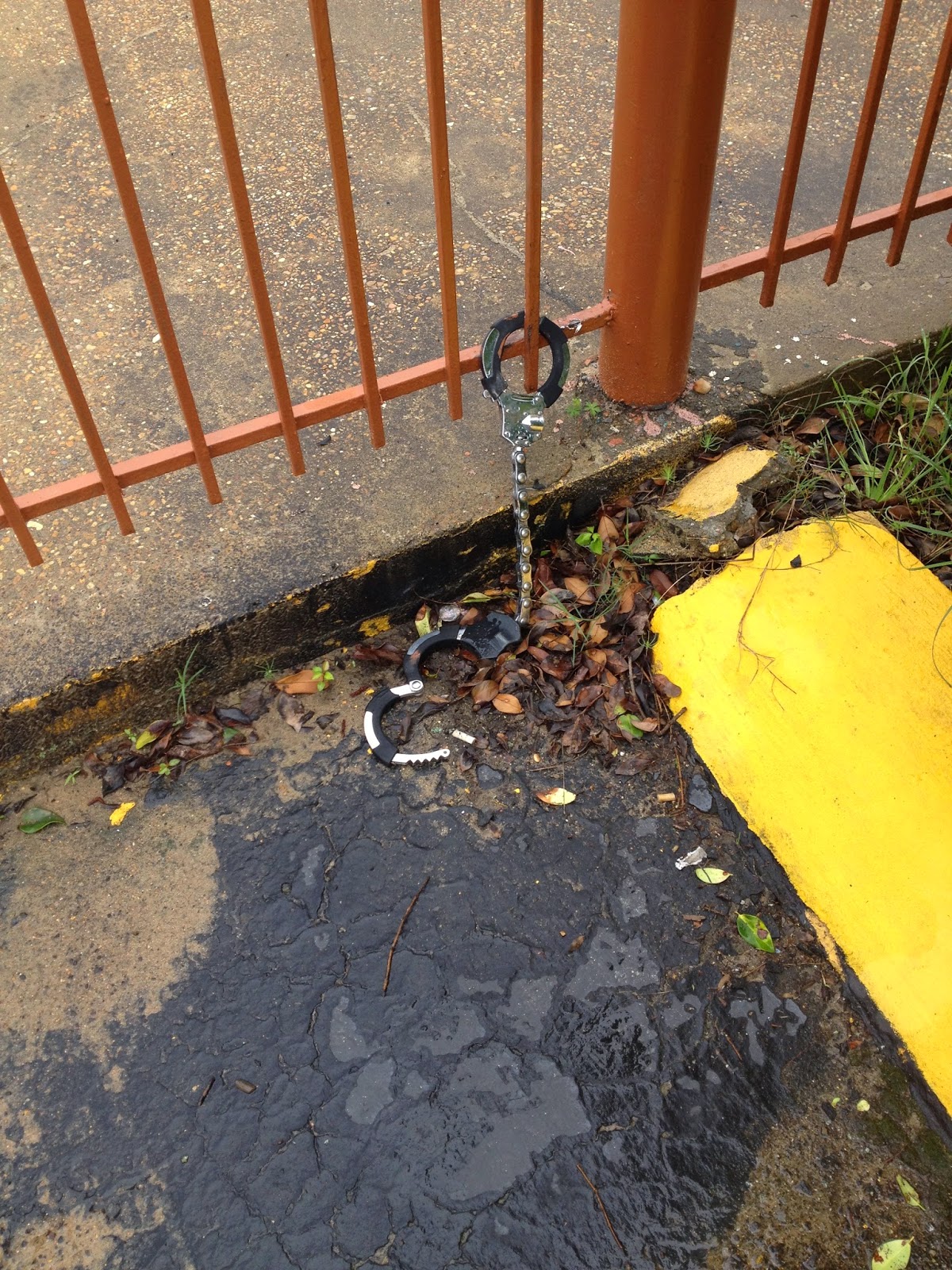
Monday, April 13th, 12:00pm: It looks like it might rain today, so we stay at the hotel and clean and sharpen shovels. This company hasn't exactly been putting us in fancy hotels, but I'm still a bit disturbed when I notice some handcuffs connected to a fence around what used to be the pool.


Like....those are not cheezy magician handcuffs. Nor are they pink and fuzzy. Those are legit handcuffs. WHY IS THIS A THING?